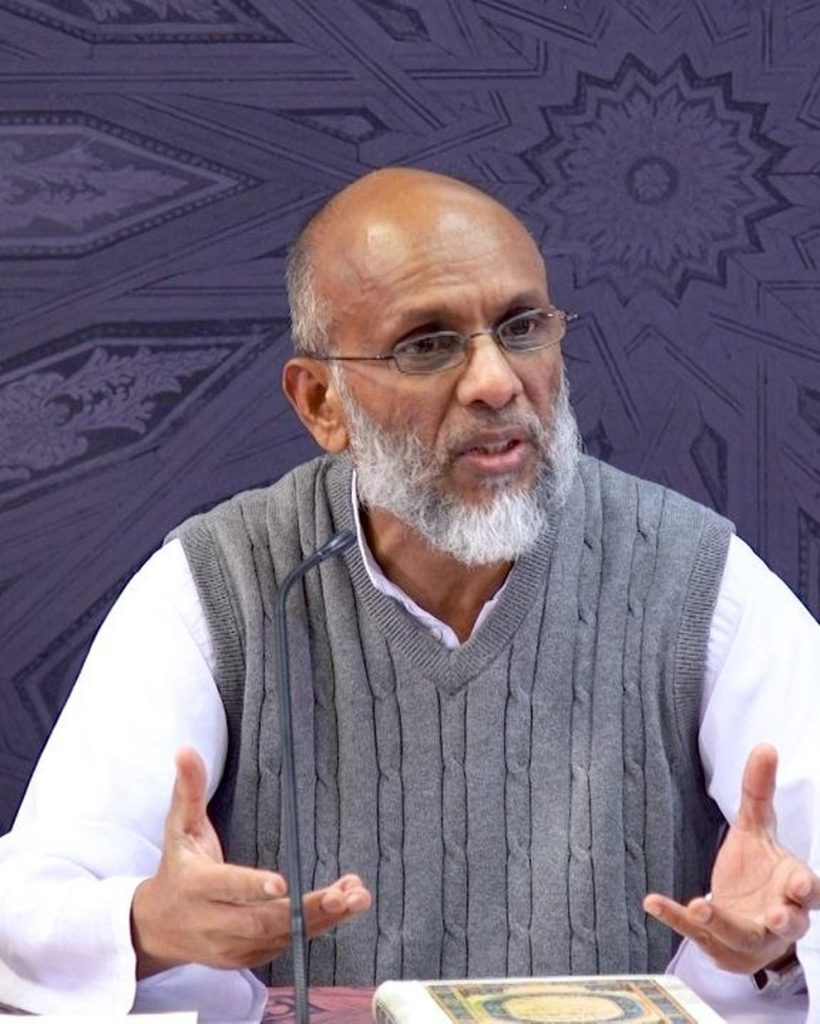
Shaykh Akram Nadwi is an Islamic scholar, author and teacher with more than four decades of work in teaching, research and writing. His scholarship spans Hadith, fiqh, Arabic language, tafsir, Islamic history and the wider intellectual tradition of Islam, and includes more than 80 books, over 1,000 articles and major multi-volume research works.
Early Life and Education
Born in Jamdaha, a village in Jaunpur, Uttar Pradesh, India, Akram Nadwi grew up in a home in which the Qur’an, language and learning formed part of daily life. His father was a hafiz of the Qur’an and had a foundational knowledge of Persian and Arabic. From an early age, he developed a strong interest in reading, particularly Persian, Urdu, history and Islamic learning.
He began his formal studies in Persian at Madrasah Diya al-Ulum in Mani Kalan, studying classical works including the Gulistan, Bustan and Akhlaq-e-Muhsini. He later continued reading Persian literature independently, including the Diwan of Hafiz and Rumi’s Mathnawi.
He then turned to Arabic, studying for three years at the Maulana Azad Educational Centre in Usharatha, where he developed a strong foundation in Arabic grammar and the linguistic sciences in preparation for his subsequent advanced studies.
Nadwat al-ʿUlamāʾ and Scholarly Formation
He then joined Nadwat al-ʿUlamāʾ in Lucknow, where he completed his ʿĀlimiyyah degree and an MA in Ḥadīth Studies with first-class honours, graduating at the top of his class. He was appointed to teach at Nadwa directly by its then director, Mawlānā Abū al-Ḥasan ʿAlī Nadwī.
While teaching at Nadwa, Dr Akram studied at Lucknow University, completing a BA in economics and then a PhD in Arabic Literature, combining traditional Islamic learning with formal academic research. His teacher and mentor, Mawlānā Abū al-Ḥasan ʿAlī Nadwī, recognised his abilities and selected him to represent him in England. This marked the beginning of a new phase in Dr Akram’s scholarly life and influence.
Oxford and Research
In 1991, Dr Akram moved to England and entered a new phase of scholarly research and teaching. Over many years in Oxford, he engaged deeply with both the Islamic scholarly tradition and the methods, assumptions and questions of Western academia. His research covered a wide range of fields, including ḥadīth sciences, Islamic legal thought, Sufi orders in India, Arabic literature, logic, philosophy and Islamic historiography. His time in Oxford strengthened his appreciation for the methodological precision of the great ḥadīth masters, especially Imām al-Bukhārī and Imām Muslim, and deepened his engagement with major scholars such as Ibn Taymiyyah, Ibn al-Jawzī and al-Dhahabī.
Today, he serves as Director of Research at the ASI Research Centre for Islamic Studies.
Scholarship and writing
Dr Akram has written and contributed to numerous works in Arabic, Urdu, Persian and English. His scholarship includes translations, critical editions, original monographs and teaching texts used by students of Islamic knowledge around the world. Among his best-known contributions are his works on Arabic grammar, morphology, uṣūl, ḥadīth, fiqh, tafsīr and Islamic intellectual history. He has also written on major figures such as Imām Abū Ḥanīfah and Mawlānā Abū al-Ḥasan ʿAlī Nadwī.
His most celebrated work, Al-Muḥaddithāt: The Women Scholars in Islam, and his wider books and research are explored on the Publications page.
If The Oceans Were Ink, published in 2015 by journalist Carla Power, chronicles a year she spent studying Islam and the Qur’an with Shaykh Akram. The book was a finalist for the Pulitzer Prize.
Teaching and legacy
He is the Principal of Al-Salām Institute; this and his other institutional roles are detailed on the Organisations page.
Shaykh Akram Nadwi’s legacy lies not only in the books he has written, the texts he has edited or the courses he has taught. It lies also in the students he has nurtured, the institutions he has helped build and the revival of a serious, principled and deeply rooted approach to Islamic scholarship. His work continues to inspire students, teachers and seekers of knowledge across the world.