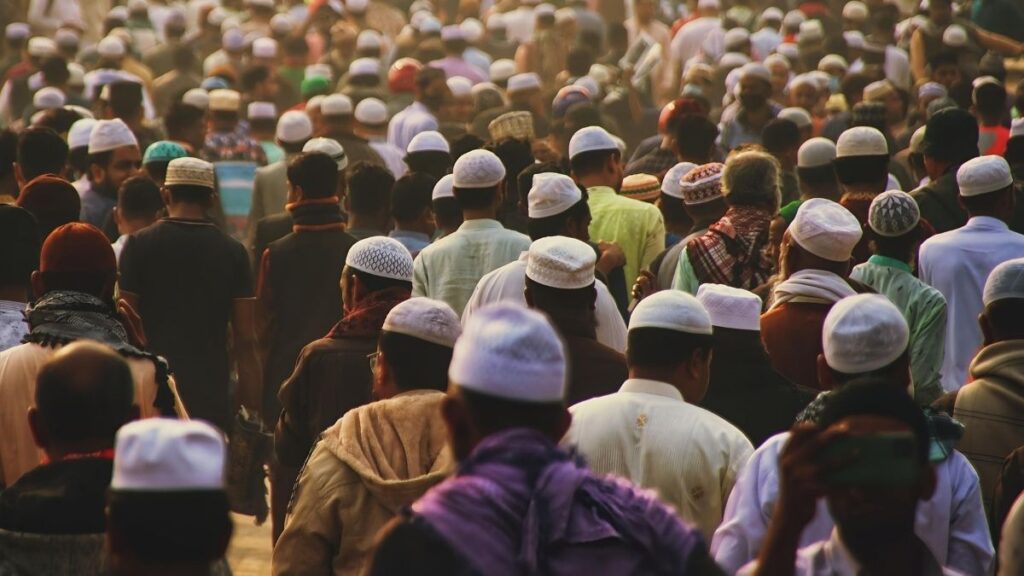
Unity And Solidarity


It was a depressing and distressing experience for me, at a recent
visit to a mosque here in the north of the UK, to hear the call to prayer and
then observe that some Muslims did not respond by joining in the lines for the
prayer. Rather, they formed, later on, a separate jama`a for the same prayer in
the same mosque. Apparently, the divisions among the Muslims attending this
mosque were stronger and more important for them than the command, from God and
His Messenger, ﷺ, to hasten to the prayer and to
make the lines for it. Among the many benefits that the institution of prayer
brings to us, in this life and the next life, there is the good that comes from
standing together for a common purpose. In doing this, we express the humility
that is proper to our dignity as servants and worshipers of the One God.
If we
express that humility with a conscious understanding of doing it, we naturally
expel the consciousness of what makes us different, unequal, incompatible, and
we admit the consciousness of what makes us the same, equal, compatible.
God’s Messenger used to say to Bilal, ‘Bring us relief, rest’. For
him and his Companions the call to prayer signalled an opportunity to rest from
the business at hand, to get free of it, to settle their hearts, and to turn
their attention to the most important of all business, the most pressing of all
realities. Inna li-l-lahi wa-inna ilayhi raji`un. We say these words on
occasions of calamity, most often when we hear news of someone’s death. We do
so because the meaning of these words puts all matters into perspective and so
calms us down. “Indeed it is to God we belong, and indeed it is to Him that we
are returning.” There is no creature living to whom these words do not apply.
We all know these words, and we all understand their meaning. How
then is it possible that belonging to some group can be more important than the
belonging to God? And if this group
belonging is strong enough to refuse even
the call to prayer, which is a call to jama`a, to symbolise and express
unity and solidarity – then, surely, this is a very strong, clear signal that
there is something seriously wrong with such group- belonging. For a start,
this belonging is functioning as a distraction, a dissuasion, from the
occasions and purposes of congregational prayer.
The commands to unity
God and His Messenger, ﷺ, have
commanded unity and solidarity. We should face attacks on the religion as a
solid wall of defenders… We should desire for our brothers and neighbours what
we desire for ourselves…. We should care about their need and distress as one
part of the body cares about suffering in another part… All these commands and
counsels are well-known to us, but we seem unable to act upon them. The consequence
is that, far from being a solid wall of defence for the religion, Muslim groups
are at war with each other and look for allies and supporters from among the
enemies of Islam, in preference to seeking unity among themselves.
Why group divisions persist
Though people will not admit it, it is obvious that groups are
functioning as a way of consolidating themselves, of preserving the differences
that make them distinct groups. Whatever the initial reason for being a
distinct group, that reason becomes unimportant or gets forgotten in favour of
just being different from another group. Pride in being of the group, the
honour of the group, become more important than being a believer, more
important than the well-being of the religion, more important than obedience
and love for God and His Messenger.
Once matters have deteriorated as far as they have, it is
difficult to find the will to change, and to identify the means to achieve
change. All that is possible is to take small steps, and then, provided we
continue to take these small steps in the direction of improving solidarity,
eventually there will re-emerge, in-sha’a Allah, a theory and practice of unity.
Public conduct and private differences
We can make a start by distinguishing matters of general and
public concern, from matters that concern the internal affairs of individuals
and the groups they identify with. Even the cleverest and wisest people, when
they go to an airport or a railway station, know that there is a system in
place, a way of doing things, and so they take instruction from people in
charge there, whatever the condition of those people. Normal good manners, and
the practicality of getting things done that everybody wants done, require
consent and observance of the way things are arranged. So then, if the person
appointed to call the prayer at a mosque calls to prayer, it is the normal
thing to answer that call, promptly and with good grace – in that way, the task
in which all are engaged can get started.
So also, when the person appointed to
lead the prayer leads the prayer, all those present must follow him, and they
must do so in his mistake if he makes a mistake. Again, in that way, the task
in which all are engaged gets done. Now, there is a known procedure, when the
imam has made a mistake, of how to inform him, after the prayer is concluded.
If the mistake is of a kind that requires it, the same imam will then do the
prayer again, and again all will follow him. The reason for this is that we
obey the imam because that is, on the occasion in question, the means given to
us to obey God. In truth we obey God’s Messenger because God explicitly
commanded it, and we obey those in authority for the same reason. There is
always good, always comfort and ease of heart, in obeying God with good grace.
How group divisions actually form
In almost every case, different groups form on the basis of
exaggerated and unbalanced understanding of certain ideas, or on the basis of
exaggerated and unbalanced ideas about what other groups’ ideas are. Whatever
these ideas may be, there are solid, everyday conditions of life that are not
in the slightest degree affected by them. Those ideas make no difference to
someone’s pain if they have suffered a loss or personal illness, or to their
joy if someone close to them has known some happiness. In other words, it is possible, across the
divisions between groups, and it is especially commendable across those
divisions, to meet with people and exchange joys and sorrows with them, to
visit them, to dine with them, to shop with them, to relax with them.
In taking
these small steps, we are again obedient to the teaching of God and His
Messenger, ﷺ. Our God is one God, the God of the
believers and unbelievers, the God of all that is, all in need of His mercy,
all in fear of His final judgement. The Qur’an is very explicit that when that judgement
comes, even parents and children will flee from each other, having other
pressing business. Our belonging to ties of family or clan or tribe or sect
will not then interest us.
Every hurdle that we face in this life demands from us some
appropriate adjustment of position and movement so that we can get past or get
over that hurdle. Such adjustments always require some sacrifice, some shifting
of priority — of bringing something forward and taking something back. So it
is with the ideas of others that we do not like. The sacrifice needed from us
is to suspend attention on and distaste for others’ opinions. This means being silent about what
we wish to praise as ours, and what we wish to blame because it is different
from what is ours. It is often easier to sacrifice health and wealth than to
sacrifice one’s opinion – but what is required of us is not that; rather, what
is required of us is to sacrifice the need to declaim our opinions in the face
of those who hold different opinions.
God says He will make clear hereafter the
differences between different beliefs
and the groups formed around them; and He says that He will remove the rancour
from the hearts of those who make their religion pure and sincere for Him.
Moving towards that, step by step, is surely what will ease our path back to
solidarity and unity, and to the dignity of being Muslims, those who have
surrendered their will to God’s will – those who ask Him to help them do His
will, not those who ask Him to do their will.