Bosnia Journey 2026 — Day 3

From the Morning Lesson to Jajce
(This lesson, on the Qur'anic vision of Ibrahim ﷺ and the vow of the wife of Imran, is continued from our previous study session.)
That morning I continued my lesson, reflecting on the vision of Ibrahim ﷺ when he was commanded to sacrifice his son Ismail, and on the vow of the wife of Imran, who dedicated what was in her womb to Allah alone, free from worldly ties and unbound by the claims of people.
I went over with the listeners the hidden connection between the two stories: the bond of pure self-giving, and the detachment that brings a person to offer what they love most as an offering to Allah. I paused at length on the meaning of the firstborn in the history of sacrifice and election. Since the most ancient times, humanity has regarded the first fruits of its labour and the dearest thing in its heart as the most worthy of being raised to the heavens.
I then turned to the words of Allah: "You will never attain righteousness until you spend from that which you love." I explained that righteousness is not a word that is spoken or a claim that is made, but a hidden test of the heart. Souls find it easy to give from what is surplus to them, yet difficult to give what they are attached to and love. True spending is the kind that draws a person out of their own stinginess and raises them from the bondage of attachment to the expanse of generosity and contentment.
The discussion continued until ten o'clock, interspersed with questions from those present and my answers to them, so that the gathering was lively and flowing. It was as if thought were taking thought by the hand, and meanings were being born of meanings, with one reflection barely ending before another followed.
We then rose and boarded the bus at half past ten, heading for the cities of Travnik and Jajce. The road stretched quietly before us between green fields that spread as far as the eye could see. It was as though the earth had put on a robe of green silk that morning, threaded through with the shadows of trees and the waters of clear streams. On either side the mountains rose tall and awe-inspiring, crowned with a light mist that thinned at moments and thickened at others, so that one might take them for phantoms of a distant dream.
There was something of the peace of the Bosnian countryside in that road, and something of the sweetness of a nature that does not speak much yet pours a long, silent conversation into the soul. It is a conversation that stirs reflection and makes a person feel their own smallness before that quiet, ancient beauty.
When we reached Jajce, the place seemed to us like a page that had survived from a book of the Middle Ages, untouched by the centuries yet worn by wars and left to bear witness to what had passed. The old city stands on a great rocky hill, watched over by the formidable fortress with its walls and towers, while the waters of the Pliva and Vrbas rivers encircle it on every side, so that the place gathers together the beauty of nature and the majesty of history.
The first thing we did was walk to the old fortress, which after six centuries still stands like a silent guardian of the city, its stones telling what books could not. The walls extend along the slope at length, broken by ancient towers and gates, so that the visitor might believe time had stopped there since the age of the Bosnian kings and their knights. Our guide explained how the fortress began as a small stronghold on the hilltop and then expanded across the centuries. First came the Bosnian state, then the Hungarians, then the Ottomans, and each nation added something of its own spirit, its fear and its dreams to the stones.
What struck me most was the story of King Stephen Tomašević, the last Bosnian king, who fled here from the advance of Sultan Mehmed the Conqueror, only to meet his death after the fall of the kingdom. Standing there, contemplating those high walls, I felt that old cities do not only preserve the names of kings. They preserve their fear too, their loneliness, and their last hours of waiting.
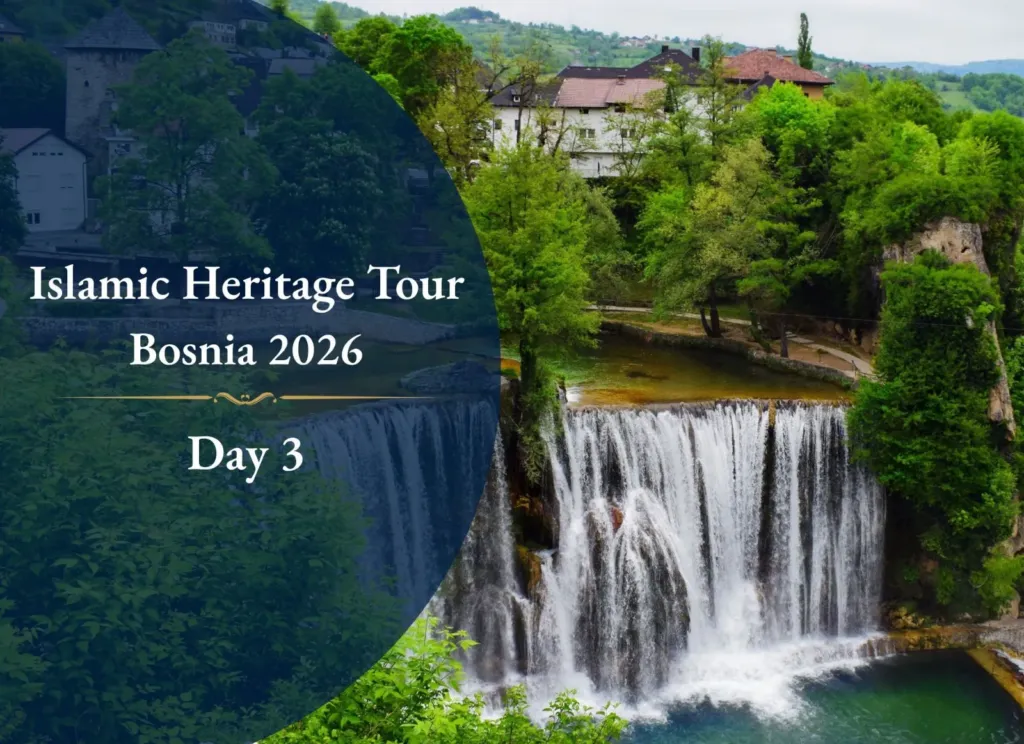
Then we descended towards the great Pliva waterfall, where the Pliva river meets the Vrbas river in a scene that catches the eyes. The water fell from on high in a continuous roar, its white foam breaking against the limestone rocks, so that the waterfall seemed like a curtain of liquid light. We were told that its height had once been greater than it is today, and that earthquakes and wars had altered its form somewhat, yet it has kept its ancient grandeur.
The whole city seemed woven around this water. The walls descended towards it, the old roads led to it, and the ancient wooden houses looked out over it in mournful silence. There I felt that water in these lands is not merely a flowing river but a complete memory, carrying the news of fallen kingdoms, the echoes of soldiers, and the sounds of muezzins and church bells together.
We then visited the Pliva lakes, both the large and the small, stretching between the mountains and forests in captivating stillness. The waters were so calm and clear that one might take them for a great mirror reflecting the sky and the trees. We were told that these lakes had formed across distant geological ages, and that nature had continued to carve and reshape them until they reached the exquisite form we see today.
Near the lakes we saw the small wooden mills, known as the mlinčići, lined up over stone barriers in a remarkable order. These mills looked like rural toys made by a humble artist's hand, yet they were once the heart of the economic life of the surrounding villages. They are built entirely of dark wood, standing on pillars of varying heights according to the slope of the land, and roofed with old wooden planks. There is no adornment or affectation about them, and their beauty lies in their simplicity and their perfect harmony with the water, the forest, and the silence.
We walked between those mills on narrow wooden bridges, the water turning beneath them in a gentle murmur, until I imagined I could hear the breaths of past centuries still lingering in that place. Some of the mills had been restored after the damage they suffered in the war, and they remained lit at night like small lamps on the water's edge.
Jajce was not merely a city of stone, but a meeting point of civilisations, religions, and eras. In it are the remains of old churches, Ottoman mosques, Roman temples, and neighbourhoods that still carry the spirit of eastern markets. The more I moved from one corner to another, the more I felt that the city belongs not to a single age but to many layered ones, where East and West, Islam and Christianity, mountain countryside and old military civilisation all stand side by side.
We left the city as the evening descended, and something of it remained in the soul, something like a longing for an age we had not lived, yet one that felt close, as if those stones and waters could return to the heart something of the memory of the first human being.
The Town of Travnik
Our other stop was the city of Travnik, a small, quiet town that rests between the mountains like a folded page of Ottoman history in the Bosnian lands. The moment we entered it, we felt that the spirit of the East still inhabits its alleys and old markets. The minarets rise gently above the red roofs, and the old houses line the slopes as though leaning on one another against time.
Travnik seemed to me a city that combines life and stillness. It is not a vast city roaring with activity, but it pulses with a quiet inner life, made by the small cafés, the old markets, and the sound of water running between the narrow stone alleys. There was something in its air of the fragrance of the Ottoman era, so that one might imagine the governors, soldiers, and merchants still passing through its streets in silence.
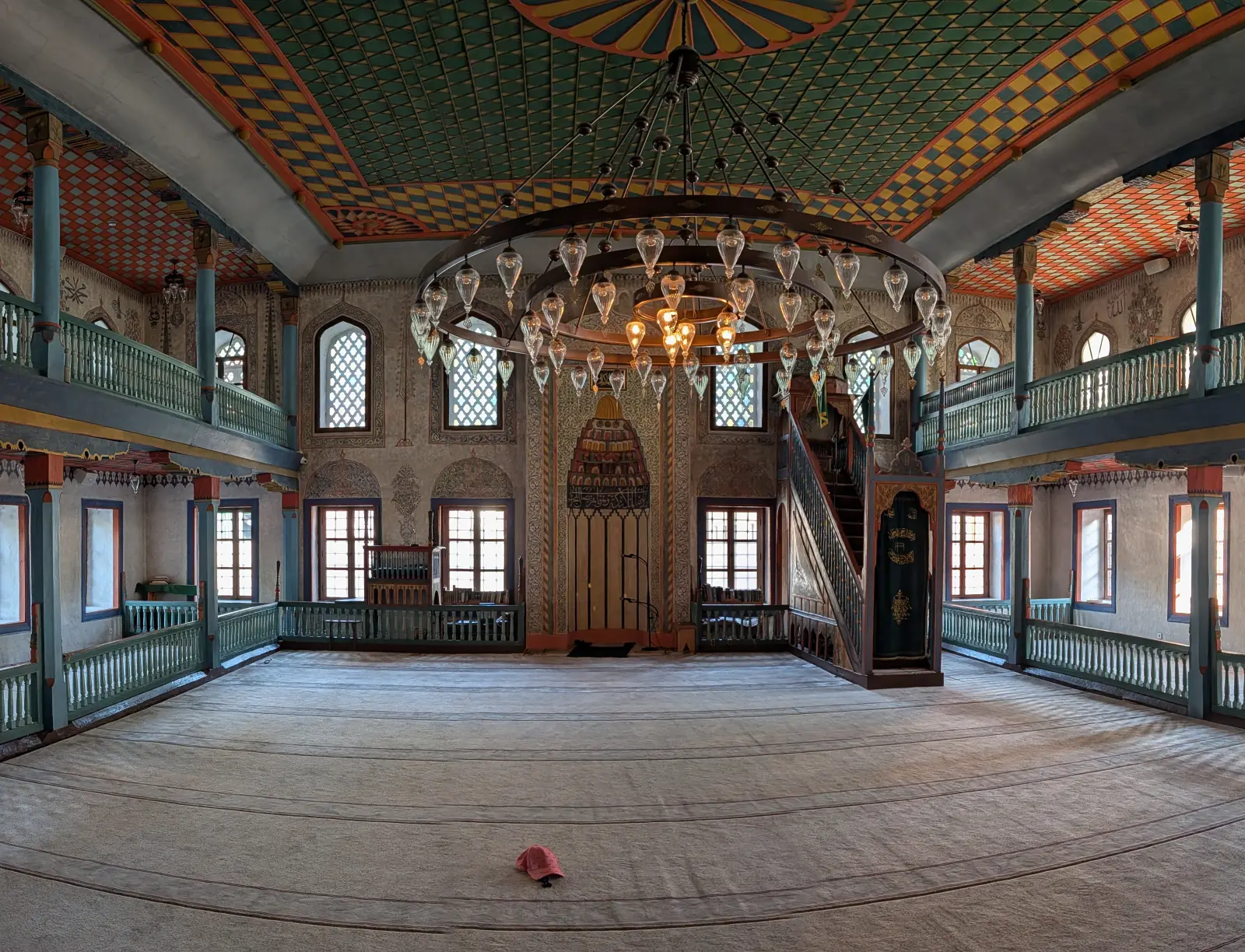
In the heart of the city we visited its famous mosque, known as the Coloured Mosque, or "Šarena Džamija", standing on the site of the old market where commercial activity once bustled with artisans, vendors, and travellers. What struck me about this mosque was a delicate beauty quite unlike the grandeur of the great mosques. Its beauty lies not in its size but in the colours, ornaments, and fine details that cover its walls inside and out. The botanical and geometric patterns intertwine in captivating harmony, so that the mosque seems like a piece of ancient eastern art, etched with flowers and colours instead of words.
The peace that fills the place gives it a special spirit. There is no noise and no crowd, only a small group of the town's people performing their prayers in quiet and calm, as though the mosque has continued to fulfil its first mission for centuries, far from the noise of the world.
Then we climbed to the old fortress that overlooks the city, one of the most beautiful and best-preserved fortresses in Bosnia. Its old walls rose above the hill in majesty, bearing witness to the kingdoms, conflicts, and armies that have passed over this land. We were told that historians differ over who built it. Some attribute it to King Tvrtko II, while others see it as the work of King Stephen Dabiša, though they almost agree that it was built in the late fourteenth or early fifteenth century.
The successive eras have left their clear marks on this fortress. The old Bosnian construction mingles with Ottoman touches added by Turkish fortification engineers, so that the fortress has become a living image of Bosnia's own history, a history across which nations and cultures have followed one another without the land ever losing its own particular character.
Sunset and the Long Road Back
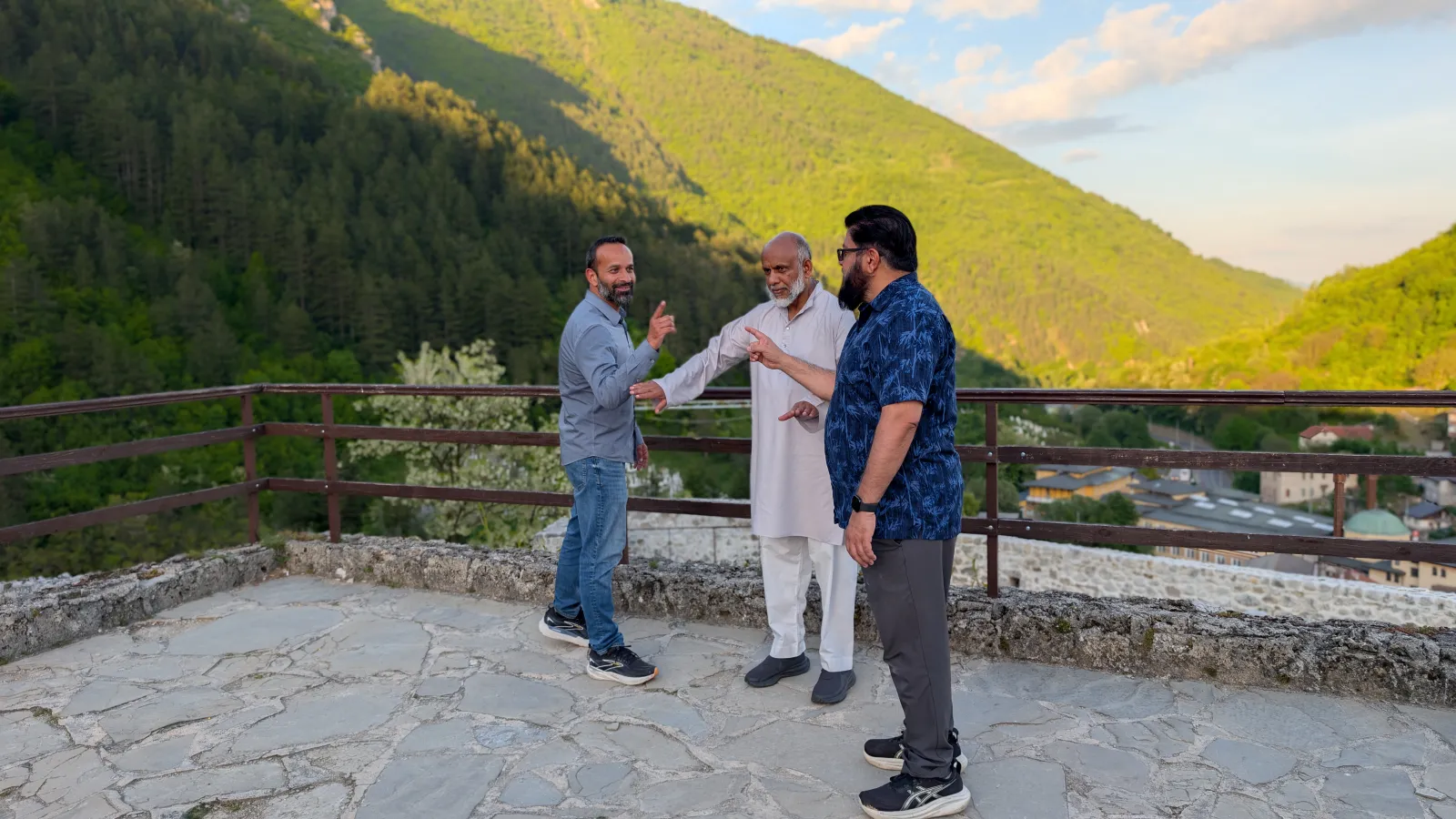
From the top of the walls we stood contemplating the city beneath us: the houses stepped along the slopes, the white minarets, the small rivers cutting their way through the green, and the mountains ringing the place in solemn silence. The view at sunset inclined towards a kind of beautiful sadness, the sadness that old cities evoke when they feel that the centuries have passed over them, and yet they still preserve their memory whole.
The people of the city reminded us that Ivo Andrić, the Nobel-Prize-winning writer, was born here, so this small town did not only produce leaders and governors, but also one who carried the spirit of Bosnia to world literature. There is truly something literary hidden in Travnik, something that makes the visitor feel that places themselves are capable of telling stories, and that the stones, markets, and mountains hold within them thousands of untold tales.
Our day had stretched long between old fortresses, ascending and descending roads, and walls that rose on the hills and then sloped down towards the rivers. We were worn out by the extensive walking, climbing, and descending, especially with the day's heat that weighed on our breaths and wearied our bodies. Every time we drank water to quench our thirst we found it warm, which only made the thirst more present in our throats, as though the summer heat had seeped even into the water itself.
Yet the beauty of those cities left us with something that made us forget a part of the fatigue, for hardship becomes bearable when the path is filled with history, nature, and memory. Perhaps the most beautiful thing about travel is that, after a long journey, one feels that the places one has seen are no longer mere passing images but have become part of one's soul, blending the body's toil with the spirit's delight.
We returned to Sarajevo at half-past nine in the evening, with darkness having settled over the mountains that surround the city, and the roads gone quiet after the day's bustle. I returned carrying within me intertwined images of water and stone, minarets and walls, the sound of waterfalls, and the shadows of forests, as if our entire day had been a journey not only through space but through the layered strata of history, memory, and beauty.
Translation note: This article was translated by AI. View the original Telegram post.